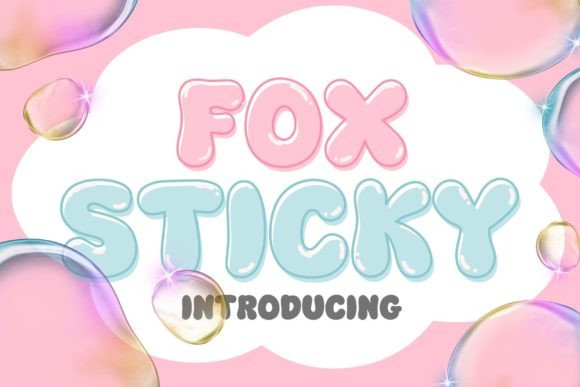
Fox Sticky: The Bold Display Font That Demands Attention
Every designer hits that wall. You've got the concept, the color palette, the layout—everything's in place. But the typography? It's flat. It's forgettable. It blends into the background when it should be leaping off the page. That's where a font like Fox Sticky changes the equation entirely. This isn't your typical safe, corporate typeface. It's a bold, playful display font built for moments when you need your text to carry as much personality as your visuals.
Fox Sticky brings an unmistakable energy to any design project. Its letterforms have a fun, funky quality—think rounded edges meeting unexpected angles, with a weight and presence that fills space without overwhelming it. There's something almost tactile about it, like the letters were squeezed out of a tube or shaped from modeling clay. That physicality gives it a warmth and approachability that rigid, geometric fonts simply can't match.
When Your Design Needs to Feel Alive
Not every project calls for a loud, expressive typeface. A financial report or a medical brochure probably isn't the place for Fox Sticky. But a surprising number of projects absolutely are—and designers often play it too safe when they shouldn't.
Consider the spaces where energy and personality actually matter:
- Children's book covers and interior layouts that need to feel inviting and playful without being childish
- T-shirt designs and merchandise where the text is the hero, not just an afterthought
- Social media graphics competing against endless scrolling feeds of content
- Event posters and flyers that have roughly three seconds to grab someone's attention
- Sticker designs and labels for small brands trying to carve out a distinct visual identity
- Packaging for kids' products, snacks, or artisan goods where shelf appeal drives purchasing decisions
In each of these contexts, Fox Sticky does something that more conventional fonts struggle with: it creates an immediate emotional response. People see it and they already have a sense of the brand or product before reading a single word. That's powerful design work, and it starts with the right typeface selection.
Building a Brand Identity Around Personality
Brand identity isn't just about a logo or a color scheme—it's about the cumulative feeling someone gets when they encounter your visual presence across multiple touchpoints. Typography plays a massive role in that equation, and it's often the element that gets the least strategic attention.
If your brand personality skews toward playful, approachable, energetic, or youthful, Fox Sticky can anchor your visual identity in a way that feels authentic rather than forced. Imagine this display font on a bakery's window signage, then on their packaging, then on their Instagram posts, then on their loyalty cards. That repetition builds recognition. Customers start associating that specific typographic voice with the experience of the brand itself.
The key is intentionality. You wouldn't pair a font like Fox Sticky with a muted, minimalist design system and expect cohesion. But if your brand embraces color, texture, and a sense of fun, this typeface becomes a natural extension of that philosophy. It works particularly well for:
- Children's clothing lines and toy brands
- Craft breweries and casual food brands
- Music festivals and entertainment venues
- Podcasts, YouTube channels, and content brands targeting younger demographics
- Artisan makers, Etsy sellers, and small-batch producers
- Party supply companies and event planners
The common thread? These are brands and creators who want to feel human, approachable, and memorable. Fox Sticky delivers that without trying too hard.
Practical Tips for Working with a Display Font
Using a bold display font effectively requires some restraint and strategy. Here's what experienced designers know about making typefaces like Fox Sticky work in real-world projects:
Don't overuse it. Display fonts are designed for headlines, titles, and short bursts of text—not body copy. Setting an entire paragraph in Fox Sticky would be exhausting to read. Use it where impact matters most, then pair it with a clean sans serif or simple serif font for longer text blocks. A combination like Fox Sticky for headings with something like Open Sans or Lato for body text creates visual hierarchy without sacrificing readability.
Test it at multiple sizes. A font that looks incredible at 72 pixels on your screen might lose its charm at 24 pixels on a mobile device. Before committing to any design, preview Fox Sticky across the actual sizes and formats where it will appear. Print a test page. Pull it up on your phone. Check it on different screens. The letterforms should remain legible and distinctive at every intended size.
Consider your color and background choices. Because Fox Sticky has a strong visual presence, it pairs beautifully with bold colors and high-contrast backgrounds. But it can also work in more restrained palettes if you give it enough breathing room. White text on a deep teal background, or a vibrant orange against cream—these kinds of combinations let the font's personality shine without creating visual chaos.
Respect the spacing. Bold, playful fonts often benefit from slightly adjusted letter-spacing and line-height. Don't just accept the default metrics. Experiment with tracking and leading until the text feels balanced and comfortable to read. Even small adjustments can transform good typography into great typography.
From Screen to Print and Everything Between
One of the practical advantages of a well-crafted display font is versatility across media. Fox Sticky translates effectively from digital applications to physical ones, which matters enormously for brands and creators who operate across multiple channels.
Think about a small business owner who designs a logo, then needs it on their website, their business cards, their product packaging, their social media profiles, and maybe even a banner for a trade show. A font that only works at screen resolution or only works in print creates friction. You end up substituting typefaces across different applications, and your brand identity starts to fragment.
When evaluating any creative font for a project, check what's included in the package. Does it offer multiple weights or styles? Are there alternate characters or ligatures that give you more creative flexibility? These details matter when you're building out a comprehensive design system rather than a one-off graphic.
Also worth noting: licensing. If you're using a commercial font for client work, merchandise, or anything that generates revenue, make sure you understand the license terms. Many premium fonts come with clear commercial licensing, but the specifics vary. Some licenses cover unlimited personal and commercial use, while others have restrictions based on the number of projects or the type of distribution. Reading the fine print upfront saves headaches later.
Making Typography Work Harder for You
Here's something that separates good design from forgettable design: the typography isn't just present—it's doing work. Every font choice should serve a purpose beyond filling space with letters. Fox Sticky, used thoughtfully, accomplishes several things simultaneously.
It sets a mood before anyone reads the content. It differentiates your design from competitors using the same handful of overused fonts. It creates consistency across platforms when you apply it as part of a defined visual system. And it invites engagement—people are more likely to stop scrolling, read a headline, or pick up a product when the typography sparks curiosity or delight.
That's the real value of investing in the right typeface. It's not about collecting fonts for the sake of variety. It's about finding the ones that genuinely align with your creative vision and your audience's expectations, then using them with purpose and precision.
Fox Sticky won't be the right fit for every project—and that's fine. No single font is. But for the projects that call for boldness, personality, and a healthy dose of fun, it delivers exactly what it promises. Sometimes the best design decision is choosing a typeface that refuses to blend in.